From performing as a child in Florida to earning a PhD before the age of 26 and building a new life in Sydney, the literacy researcher, lecturer and singer is discovering where her curiosity can take her.
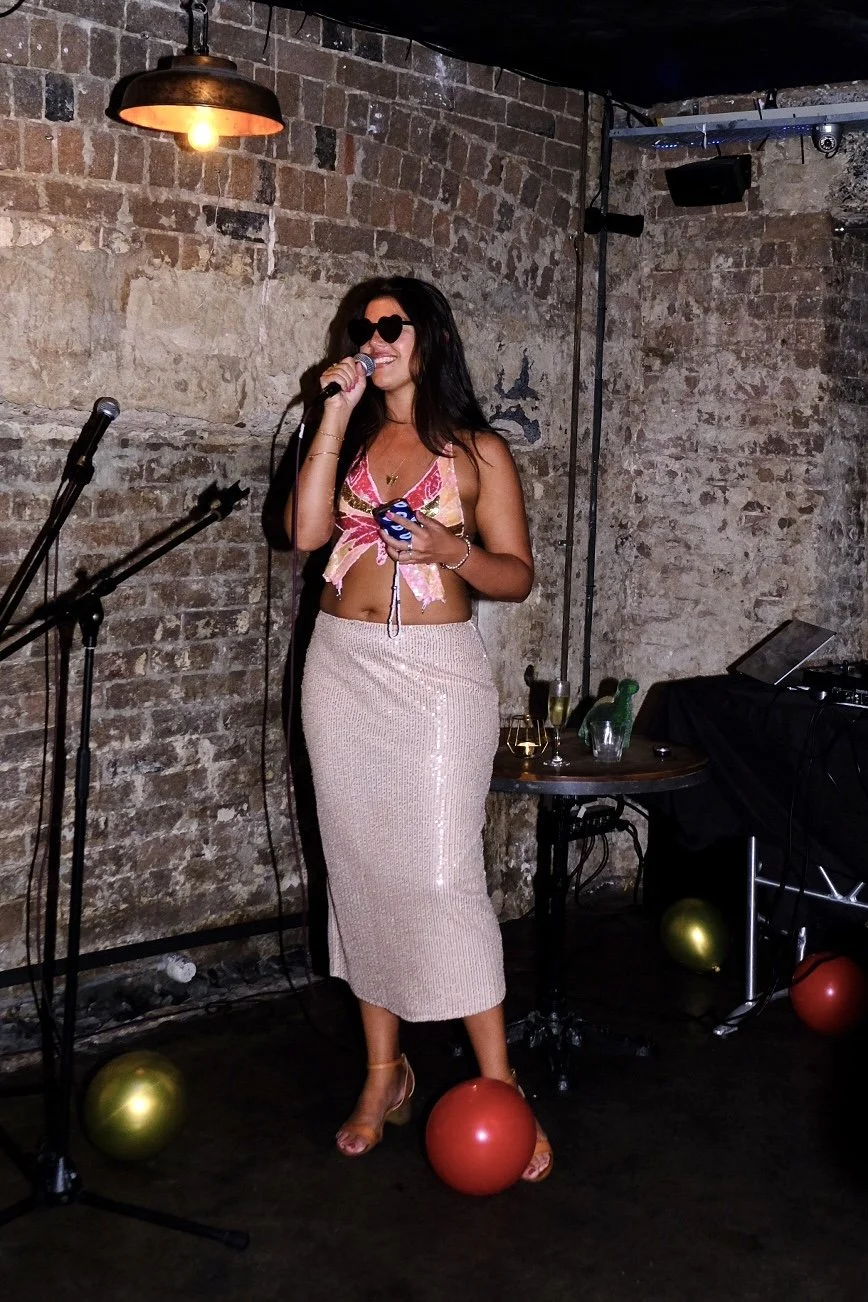
Valeria giving a speech at my birthday party on 7 March 2026.
I first met Dr Valeria Rigobon at a Sydney meet-up in 2023, a couple of months after I had moved here. I was on a quest to make more friends and had spent the evening chatting with people. However, I had not quite found that spark of connection. Then I turned around and saw Valeria. She was luminous in the crowd, someone I immediately wanted to get to know. I went over to say hello, only to discover that she was leaving. We exchanged Instagrams anyway. Three years later, here we are.
We later discovered that we had both moved to Sydney in the same month. Our first few catch-ups also revealed a shared talent for choosing venues where the music made conversation almost impossible, so we became friends while practically shouting across the table. Since then, we have connected over wine, her love of gin and our shared love of music. We have seen Infinity Song, Laufey and MARINA together; Valeria bought us both tickets to see MARINA in February 2026 as my birthday present.
What I love about Valeria is her warmth, her kindness and her zest for life. I have also watched her perform with her band. Her voice has a beautiful depth and warmth, and her rendition of Make You Feel My Love brought tears to my eyes. Alongside her music, she completed a PhD in developmental psychology at Florida State University before the age of 26. I wanted to understand how those parts of her life had come together.
For all the hours we have spent discussing everything and anything, I had always wanted to sit down and map out Valeria’s life: to start at the beginning and understand how she arrived where she is now. I love discovering how people’s experiences, decisions and interests connect. It is a large part of why I started this interview series. On 12 September, over lunch in Surry Hills, I finally got to do exactly that. We were both in the midst of moving: Valeria had just moved, and I was due to follow the week after. Naturally, we began with her moving troubles before eventually finding our way back to Tampa, Florida, and a little girl who already knew she could sing.
“I Knew I Was Good”
Valeria describes her early childhood in Tampa as “quite charmed”. She grew up in a suburban neighbourhood with school nearby, friends and a sense of safety. “I think I was a pretty happy kid,” she tells me. Music entered that world early. Her parents joke that she sang before she talked, and she began singing in a Catholic church choir. Her enthusiasm for that particular ensemble, however, did not last. After her first year, her mother asked whether she wanted to continue. She said no. Her assessment of the other children’s singing had been somewhat unfavourable. “I mean, I knew I was good,” she says. “I’m not gonna lie.” I suggest that she was already Beyoncé.
The opportunity to do something more came through a babysitter who heard her singing. Her daughter belonged to an all-girls performance group in South Tampa, and she thought Valeria might enjoy it. Her mother agreed to take her to audition, without quite knowing the commitment that would follow. There was a dance to learn and perform, followed by a solo. Valeria had never auditioned in this way before. Nevertheless, she quickly noticed a pattern. When the judges struggled to hear a girl, or an audition was not going well, they sometimes stopped the music and asked her to sing Happy Birthday.
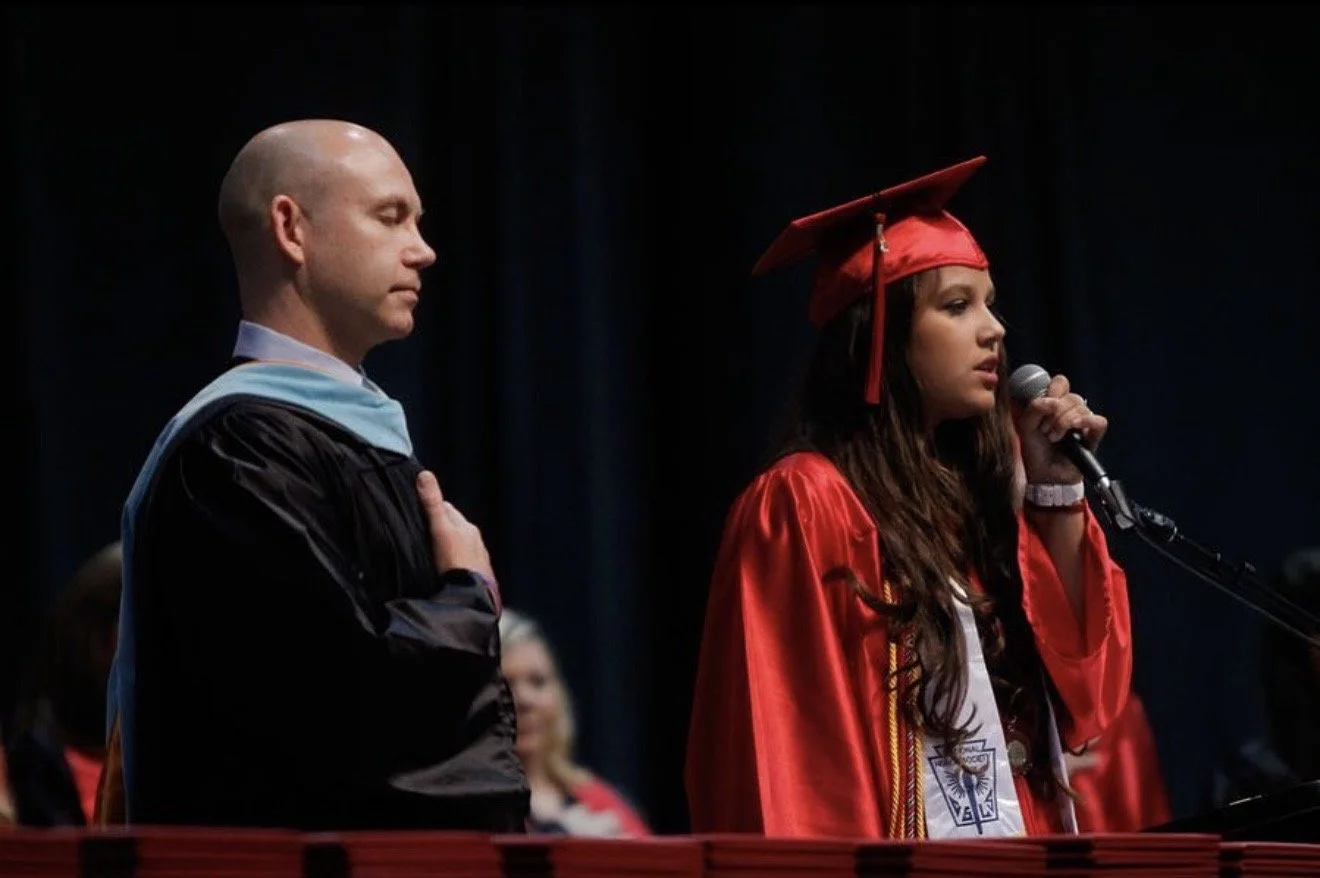
Valeria singing the American national anthem at her high school graduation.
Valeria arrived with a track that still had the original vocals on it. She began singing over them, and the judges stopped the music. Her heart started racing. “I know I’m better than this,” she remembers thinking. She asked whether she could sing her chosen song without the track instead. The judges asked whether she meant a cappella. The term was unfamiliar; the idea was exactly what she had in mind. She sang, went home and began checking the mailbox. “I remember I was eagerly checking the mail every day for, like, a week.” The invitation eventually arrived: she had been accepted into Entertainment Revue.
It became a central part of her life until she finished high school. Her parents drove her across the city for rehearsals, sometimes an hour each way, at least twice a week. As she progressed, weekend rehearsals could stretch to six or eight hours. There were performances at community events, Christmas festivals and private functions. There were also friendships and lessons that extended beyond performing. It was where she learned “how to be disciplined about not just music”, she explains, as well as “how to be organised” and “how to work in a team”. Looking back, she recognises the time and money her parents invested in making that possible.
Her director had high expectations and could be harsh, she recalls. She also cared about the girls’ development and encouraged Valeria to pursue music. She helped her secure her first paid job: singing at a wedding when she was about 15 or 16. Other weddings, funerals and private performances followed. Alongside singing and dancing, Valeria learned guitar at her father’s encouragement. Her teacher welcomed the songs she wanted to learn while also introducing classical pieces and music theory. Music was becoming both a serious commitment and something she could imagine building a working life around.
When the Plan Changed
Music therapy seemed to offer a way to combine music with helping other people. Valeria auditioned successfully for several university music programmes and imagined leaving Florida to experience somewhere different. “I had big dreams of moving out of state,” she recalls. However, affordability narrowed her options, and navigating admissions proved more complicated than she had realised. Valeria’s family is originally from Venezuela, and her parents had attended university outside the United States. The American admissions system involved requirements that were unfamiliar to the family, and Valeria missed the music audition deadline at Florida State University, where she ultimately enrolled.
She began studying psychology while continuing to try to enter the College of Music. The difficulty was that Florida State required a classical audition. Valeria had grown up performing contemporary music and learning largely by ear. She had never had a voice lesson. Now she was trying to train herself in a style she appreciated without enjoying singing it. “I was like, ‘This is not me.’” She recognises the skill involved in classical singing, describing it as “truly its own art form”. Performing it herself was another matter. She tried repeatedly. The auditions ended in rejection, while her psychology degree continued in the background.
During the summers, she volunteered with music therapists, hoping practical experience might strengthen her prospects. She considered finishing psychology and pursuing music therapy through postgraduate study. Then one of the therapists offered advice she had not expected: reconsider. Valeria remembers a frank discussion about the cost of another degree, the financial realities of the work and the difficulty of making the career sustainable. “I remember being so shocked when she told me that,” she says. Nevertheless, she appreciated the honesty. She was approaching the end of her psychology degree and needed to think seriously about what came next. “I need to pivot. And I need to do something else.”
We talk about those conversations that feel like a crushing disappointment at the time, then look different with a few years of distance. I recognise the experience of being so attached to a future that changing it initially feels like losing something essential. Valeria had some teaching experience by then. She had volunteered as a music teacher in Peru and could imagine teaching at university. “I could see myself teaching at the university level,” she says. Research had not yet become the obvious destination.
A mentor suggested a PhD in psychology. Valeria was surprised to discover that this was even a possibility. “I genuinely didn’t even know that you could go to graduate school for that,” she explains. She had understood postgraduate study as something people did to enter certain professions, without really thinking about how her own professors had reached their positions. The route into academia began with someone explaining that there was a route at all.
The People Who Opened Doors
Her first research opportunity had come much earlier, largely because her mother encouraged her to apply for a programme for first-year university students. Valeria was initially unconvinced. “I just want to, like, do my coursework, be in an a cappella group and, like, call it a day.” Her mother persisted. Valeria applied and joined a project led by Dr Lara Perez-Felkner, whose research examined the effects of affirmative action bans on university enrolments among underrepresented groups.
At 18, Valeria had not fully grasped the significance of her own access to university: scholarships, family support and the opportunity to study without taking out loans. Working on that research began to change her understanding. Perez-Felkner was also the only Latina professor she encountered during her undergraduate degree. “Getting to learn about her work and getting to learn under her supervision was actually much more impactful, I think, than I had realised in the moment,” she reflects.
When the placement ended, Valeria emailed to ask whether she could continue volunteering. She received no reply and assumed that perhaps her help was no longer wanted. When they crossed paths later, she discovered that the email had simply been missed. It was an early lesson in something many of us learn with experience: sometimes, you need to follow up. Silence does not always mean what you think it means. The experience also helped her feel more confident approaching other researchers and asking whether they needed an assistant.
Other opportunities followed. An ethnomusicology researcher needed help translating material from Spanish. Valeria spoke Spanish and wanted to be involved. The connection was made. In another case, a research methods lecturer called her into her office. Valeria worried she was in trouble because she had been skipping some classes she found dry. Instead, the lecturer told her she was among the strongest students and offered her a research assistant position. She initially declined. She was still trying to get into music.
After another unsuccessful audition, she returned to the offer. That lecturer later helped her consider doctoral study and find a position with Dr Don Compton, who would become her PhD supervisor. His undergraduate class on dyslexia brought several longstanding interests together. Valeria had volunteered with children who struggled to read. She had entered spelling bees because she liked words. Her father, who speaks five languages, encouraged her interest in vocabulary and where words came from. Compton’s class helped bring together interests she “didn’t really know could fit together in a job”. She also loved how he taught: engaging, informal and comfortable enough to take off his sandals and walk barefoot around the classroom.
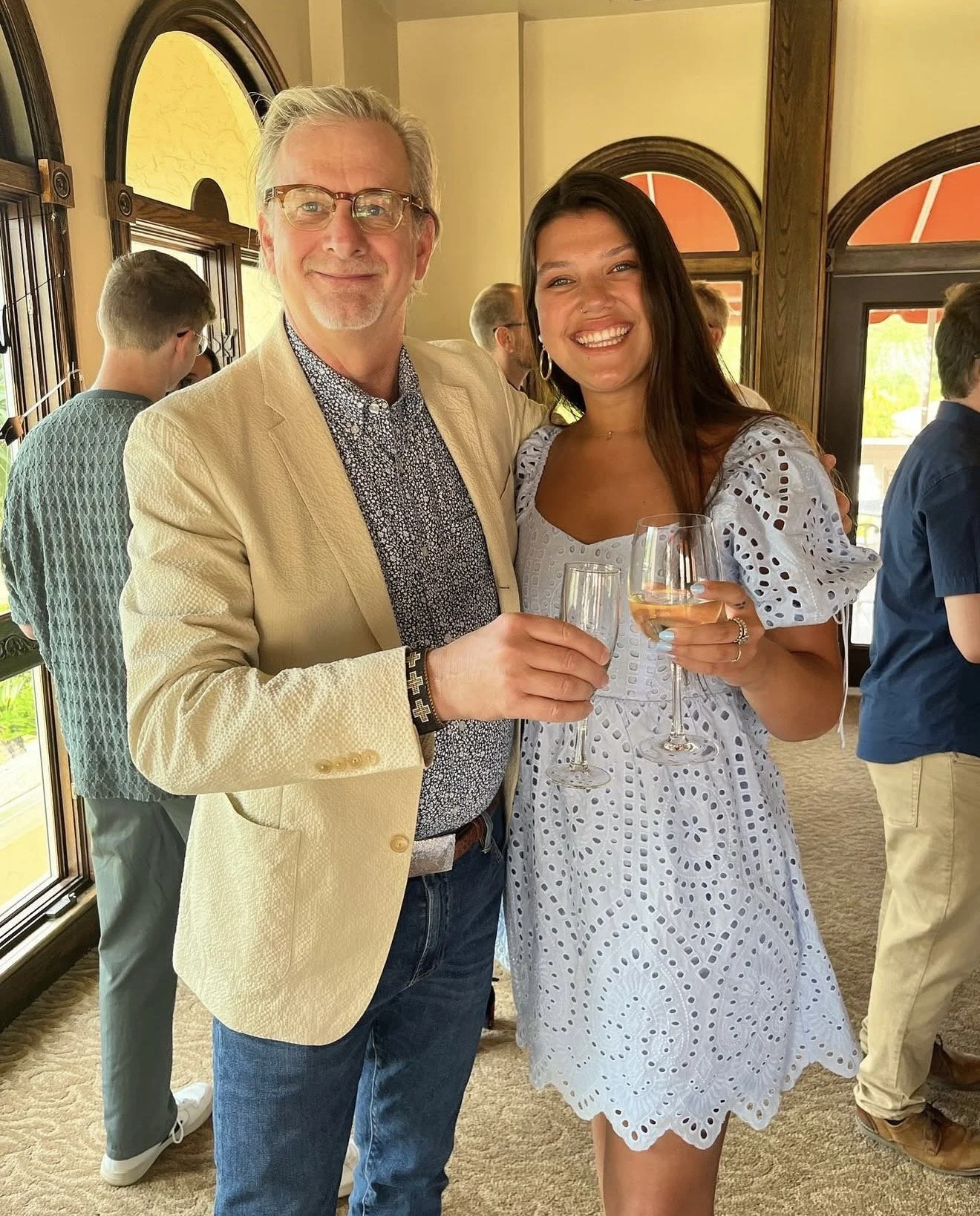
Valeria and Compton celebrating her PhD.
Compton’s influence extended well beyond the classroom, shaping the way Valeria came to see her own abilities. “Genuinely never let me talk down about myself,” she says. “Never let me think that I wasn’t gonna be successful.” His encouragement came with an understanding of when to push her and when to remind her to slow down. “He kind of knew when to say the right thing,” she explains. When she set punishing expectations for herself, he helped her recognise that she was still learning and did not need to have everything figured out. It is this combination of belief, guidance and perspective that leads her to describe him as “the most important mentor I’ve probably ever had in my life”.
Listening to Valeria, I am struck by her willingness to explore possibilities beyond the future she had originally imagined. Her mentors recognised her potential, and she met their encouragement with curiosity, initiative and a commitment to learning. She asked questions, sought out research opportunities and reconsidered her plans when they no longer felt right. Their guidance mattered, as did her determination to turn those possibilities into a path of her own.
Who Gets to Be in the Room?
For all the familiar accounts of doctoral misery, Valeria remembers those five years with considerable happiness. “I felt really in my element,” she says. “Felt really supported. I felt like I was learning a lot.” Her undergraduate degree had taken three years rather than the usual four. She then completed a combined master’s and doctoral programme, earning her PhD before the age of 26. She had been so young when she entered the programme that she could not legally drink at the first social event.
As her studies progressed, the balance shifted from coursework towards research and teaching. She had more autonomy over her time and was developing a working life within the university. She is conscious of what made those years possible. Funding, family support and the affordability of living in Tallahassee gave her room to enjoy life alongside her work. Her parents supported the decision to continue studying, even when the pathway was unfamiliar to them. “I’m gonna do this thing,” she remembers explaining. “It’s gonna take five years.” There was no certainty about exactly where it would lead.
A fellowship supporting scholars from underrepresented backgrounds also gave her access to a community she rarely encountered elsewhere at university. At its first conference, surrounded by predominantly Black scholars, she initially wondered whether she belonged there. “I felt like an imposter,” she recalls. That feeling soon shifted. “I was very welcomed in the space,” she says, and the purpose of the fellowship’s broader eligibility became clear.
It also made the absence of similar representation elsewhere more visible. She remembers only two Latina academics across her undergraduate and doctoral studies, one of whom taught outside her own department. She had no Black professors in her classes. The fellowship conferences offered a different experience from the university spaces she usually occupied.
For Valeria, these experiences gave new meaning to the research she had encountered as a first-year student. Questions about access and representation had become personal: who she learned from, whose experiences were reflected around her and where she could imagine herself belonging. The fellowship offered financial support alongside a community of scholars who understood the significance of being in those spaces.
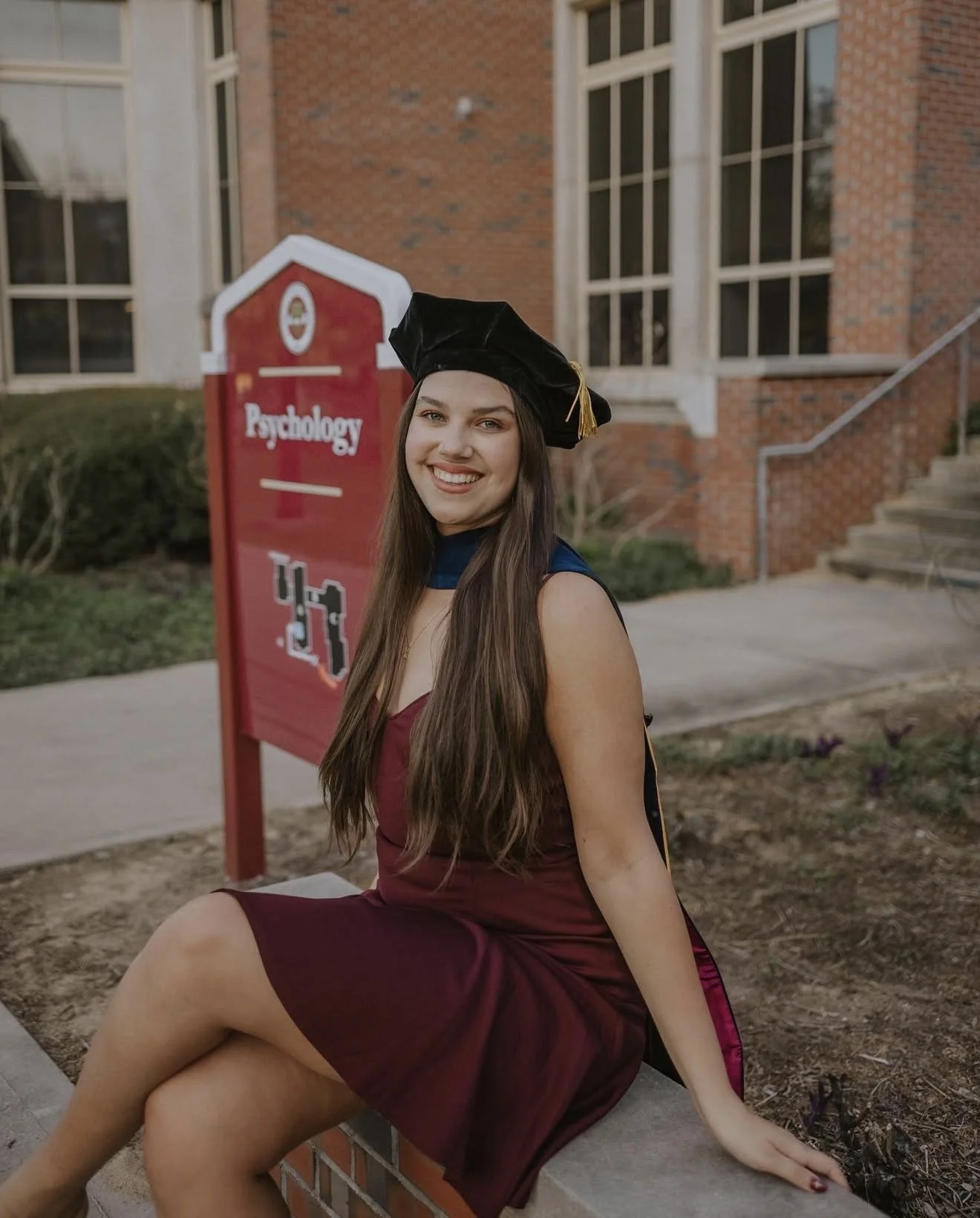
Valeria at her PhD graduation in 2023.
The Job That Was Hard to Say No To
Australia was not on Valeria’s list of places to apply for jobs. It had, however, occupied a place in her childhood imagination. She watched Bindi Irwin, studied Australia for a geography project and developed an enduring affection for the platypus. “I’ve always had Australia in my mind as just this cool, faraway place,” she says. Professionally, she was considering the United States and possibly Europe. Then Compton put her name forward for a new literacy research centre in Sydney.
He told her during a visit to Colorado. The person who would lead the centre had asked him to recommend potential recruits, and he thought she might be interested in the adventure. Valeria initially wondered whether he was joking. “Can I just confirm that you’re not kidding and that you are serious?” she remembers asking. He was serious. There was already a Zoom meeting arranged.
That evening, they became so absorbed in dinner that they lost track of time. When Valeria realised they were late, she was alarmed. This person might become her boss. Her supervisor’s advice was to join without apologising. We pause to appreciate the confidence required to offer that instruction quite so comfortably. The conversation itself surprised her. “He’s trying to sell me on why I should move to Sydney,” she recalls. She had expected something rather more like an interview.
The opportunity was still uncertain, so she continued applying elsewhere. Over six months, she submitted more than 40 applications. She attended interviews, received offers and began imagining different futures. One involved Boston. She had friends there, loved the city and could picture a life there. When that university chose another candidate, she was devastated. On the same day, her first research paper as first author was accepted for publication, and she spoke again with her prospective boss in Australia. “Everything was happening all at once,” she remembers.
The Australian position became a formal offer. She was given time to consider it, which mattered. Another job had come with pressure to respond quickly; this one allowed room for a decision of considerable consequence. “I’m not being pressured,” she remembers thinking. While staying with a close friend in Texas, she considered an opportunity that could have brought them together professionally. Her friend was honest about its limitations. She would love to have Valeria nearby, although the role might not provide the autonomy or working life she wanted. I love a friend who can say: your moving here would make me happy; let us also talk about whether it would make you happy.
Valeria tried lists and comparisons. The options were good. Yet they were different enough that she struggled to decide. “My life will be really different depending on which of these opportunities I take,” she explains. Eventually, she put the exercise aside. Then, in the shower, a thought made her pause. “Each of these jobs is so easy to say yes to but the Australian job is so hard to say no to.” She repeated it aloud, recognising that this told her something the lists had not. She decided to sleep on it. By morning, the decision still felt right.
When she told Compton, he finally admitted how much he had hoped she would choose Australia. He had tried not to sway her, although he believed it was an exceptional opportunity. Valeria also knew that if it did not work out, she had somewhere to return to. Her family and friends would still be there. “I’m always gonna have a home, that community to get back to,” she says. We discuss the privilege of having that reassurance: moving across the world feels different when you know there are people ready to welcome you back.
After arriving in Sydney in July 2023, Valeria became more conscious of how competitive academic employment could be. Some of the colleagues joining her at the same level had longer careers and more established research profiles. It gave her a greater appreciation of the expertise she had developed at the Florida Center for Reading Research and the confidence Compton had shown in recommending her. His introduction opened the conversation; her training, ability and potential gave her prospective employer compelling reasons to continue it.
Finding Her People
Accepting a job was one decision. Making a home in Sydney involved many smaller ones. Valeria had lived in Tallahassee throughout her university years. Even when friends graduated and left, she retained an established community. “This was the first time as an adult that I am not a student that I have to try to make friends,” she explains. She also knew that her colleagues would be mostly older than her, so work would not necessarily provide an immediate group of friends.
She has generally found making friends easy. In Sydney, however, it took longer. At first, she sometimes spent time with people she did not particularly connect with because she wanted company. She was open to meeting people with different experiences, while gradually learning to distinguish between being open-minded and continuing friendships that did not feel right.
Her approach was to keep trying. She went to things, including by herself, trusting that she would eventually find people she connected with. “I just need to keep putting myself in social situations and eventually I will find my people, or they will find me.” I am very glad we managed the latter before she left that meet-up. She describes the approach simply: “I just have to keep trying and it’ll happen.”
Knowing Valeria now, surrounded by friends who clearly adore her, it would be easy to assume that finding her place in Sydney had been effortless. Hearing her describe those early months reminds me how much of building a community involves continuing to show up before anything feels familiar. She gave herself time to find the connections that mattered, and it is lovely to see the life that has grown around them. Whenever I meet her friends, I am struck by their warmth. When she meets mine, the verdict is usually much the same: we love Valeria.
Making Room for Music
Music found its way into Valeria’s Sydney life through another introduction involving Compton. He knew she sang and knew that a colleague, Anne, had a husband with a band. He helped make the connection. Valeria initially imagined that she and Greg might get together occasionally to play. “I kind of thought it was just going to be like, we just jam every once in a while,” she says. Greg took the initiative to establish something more regular, including performances at The Treehouse in North Sydney. The mentor who helped her find a research career had also helped her find somewhere to sing.
Music had continued throughout university. Joining an a cappella group introduced her to singing with men after years in an all-girls ensemble. She loved the way deeper voices filled out the sound and resonated in the room. “There was something just so cool about the way a truly deeper tone can fill the sound,” she explains. Her listening expanded too. Friends introduced her to more R&B and hip-hop. A world music cultures course brought her into contact with musical traditions she had not previously explored. Although she disliked singing classical repertoire, she discovered that she enjoyed listening to some of it. Friends performing in musicals drew her towards musical theatre.
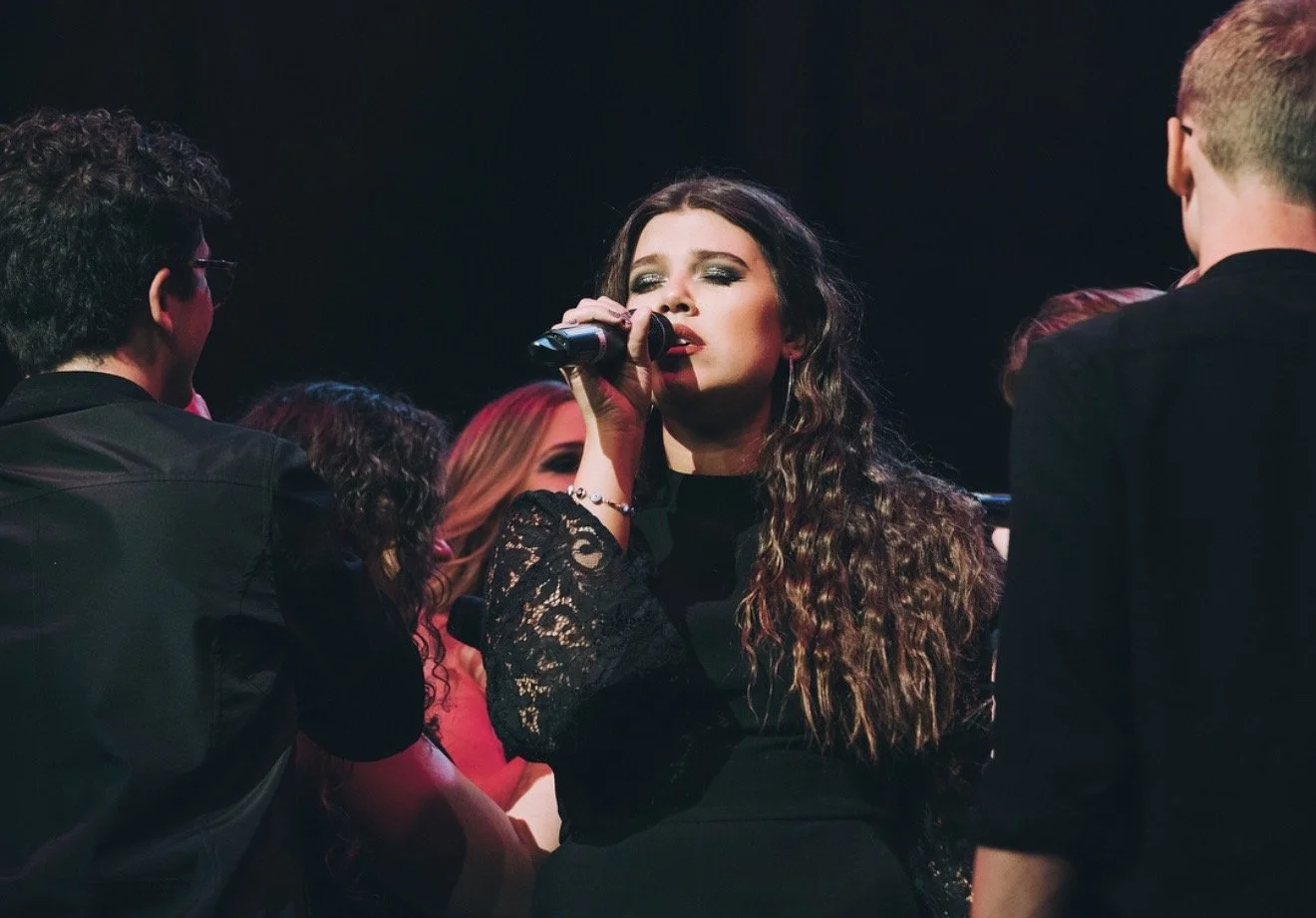
Valeria performing with her university a cappella group, All-Night Yahtzee.
Reggaeton became another pleasure, although its presence in her life was much older. Growing up, her family regularly gathered with other Latino families for parties. The music might begin with salsa and bachata, then become progressively less suitable for children as the evening wore on and the parents became more enthusiastic. “We would be dancing until, like, two, three, four in the morning,” she recalls. Even as a native Spanish speaker, Valeria sometimes struggled with the speed and dialect of the lyrics. Eventually, she stopped worrying about understanding every word and let herself dance. “I was like, ‘Wait, this slaps. This is so good.’”
Our conversation takes a considerable detour here. We discuss music that makes you move, artists who can really sing and the pleasure of introducing friends to songs they immediately enjoy, even without understanding the lyrics. Valeria is particularly drawn to artists willing to move beyond something they already know they do well. “Many of them are genre-bending,” she says of the musicians she loves. We talk about the confidence involved in developing a sound and then allowing yourself to experiment. It is a conversation that could comfortably occupy the rest of our afternoon. We both have opinions, and neither of us is particularly inclined to keep them brief.
Eventually, we return to her own music. I think about the teenager who wanted to pursue it professionally and the researcher whose voice I have heard fill a Sydney venue. Through that change of direction, singing retained its place. Today, she performs with The New Normal Sydney. It gives her people to make music with, something to look forward to and another way to be known.
One Question at a Time
When I ask how she decides what to research, Valeria describes reading other people’s work and noticing what remains unanswered. Some people enter her field after years of professional practice. They encounter something in a classroom that their training does not help them resolve, look for answers and discover a question they want to investigate. Valeria entered graduate study directly from her undergraduate degree, with broad interests in literacy, language and why certain skills are difficult for some learners. “I wasn’t propelled by a particular question,” she explains.
Her research questions developed through exposure to the field. “Why haven’t they done this yet? Or why haven’t we directly compared these things yet?” Sometimes, the next question is suggested by the researchers themselves. A paper might explain what its findings establish, then acknowledge what remains uncertain. Those unfinished parts can provide somewhere to begin.
Some of her work examines learning under specific, controlled circumstances. Other projects ask practical questions, such as which of two methods of spelling instruction works better and why. “I want to help teachers know what they should be doing,” she says. She enjoys moving between the theoretical and the applied. “I think I’d be quite disinterested and demotivated if I only did one or the other. So I like that I can do both.”
A mentor gave her a useful phrase for the approach: “incremental science”. While considering an early grant application, Valeria had struggled with how to demonstrate the value of a project. She wanted to advance knowledge and make its practical significance clear. At the same time, ambitious studies required money, and funding often depended on already having a record of conducting strong research. “To get money, you have to have money,” she says of the frustrating cycle.
Her mentor reminded her that answering smaller questions well was worthwhile. It helped establish the trust needed to pursue larger ones. Valeria took from that conversation the importance of showing “one little piece at a time that you can answer a question with really good methods”. There were valuable questions she could investigate without enormous resources. “That doesn’t mean they’re not worth answering,” she says of questions that might initially seem less exciting. I like the patience in that idea. There is value in doing one piece carefully enough that someone else can build on it.
When we discuss why literacy matters, the examples become immediate. Valeria asks me to imagine grocery shopping without being able to read the labels, relying on packaging to identify what I need. Or trying to complete tax forms without being able to read the instructions. These are tasks many of us move through without considering the reading involved. Her work asks questions about the skills that make those ordinary activities possible and what might help people who find them difficult.
Finding the Words
Language becomes one of the most personal parts of our conversation. Valeria spoke Spanish before she was exposed to English as a small child. “All my memories are in English and Spanish,” she explains. Later, academic writing became a source of frustration. As a child, she loved journalling and narrative writing. In high school, she struggled to understand how to paraphrase other people’s work. Expressing an original thought felt different from taking an existing idea and explaining it another way. “I don’t know how to say this any better,” she remembers thinking.
The difficulty began to affect how she saw herself. “Maybe I’m just not a good writer,” she recalls wondering. An English instructor at university helped restore her confidence. Graduate study then introduced another period of feeling inadequate, followed by the gradual discovery that she could learn. Reading widely within her field helped. She began seeing how different researchers wrote about related ideas, how their explanations differed and how she could bring several sources together to develop a point of her own. Hearing someone who writes professionally describe learning to do it feels reassuring. A finished paper gives very little indication of the earlier uncertainty or the teacher who helped its author believe she could write.
Valeria describes how reading more deeply within a subject allowed her to recognise different approaches to the same idea. “Once I started to find my niche and started to read a lot about what a lot of different people thought about the same topic,” she says, those connections became easier to make. She could see how to develop her own explanation, rather than feeling confined to the wording of the first source she encountered.
We talk about the experience of knowing a word in one language and momentarily struggling to retrieve it in another. About the languages we understand more easily than we speak. About how much practice depends on who is around us and which parts of ourselves we use each day. Valeria’s research considers particular questions about reading, spelling and language. Our conversation reminds me of how those skills enter a much larger life. They help us navigate forms and workplaces, as well as encounter ideas, tell stories and make ourselves understood.
“More Than Okay”
Towards the end, I ask Valeria what she would tell her younger self. “It’s actually going to be more than okay,” she says. “Things are actually going to be way better than you can even visualise.” There is an emotional weight to her answer, a gratitude for a life that has unfolded in ways her younger self could not have anticipated. “I can’t even tell you what’s gonna happen because you won’t believe me.”
As she explains why, she returns to something familiar: evidence. “I’m a believer in science. I’m a believer in the evidence.” Looking at her own life, she sees reasons to trust what might come next. “The evidence would suggest that I should predict joy and well-being and finding my people because I’ve already been able to experience that.” She reflects on what has made that life meaningful: “Being in the environment I need to be, finding my purpose, finding my people.” Her conclusion is simple: “I just need to trust.”
Valeria has worked for the life she describes, through years of study, rejection and the courage to change direction. She has taken chances, trusted her abilities and stayed open to possibilities she had not imagined. Music brought her to the stage. Research brought her to Sydney. Her curiosity has made room for both.
Where to Hear Valeria Sing
Valeria performs with The New Normal. Having watched her perform, I would highly recommend experiencing her voice for yourself. Follow them on Instagram and catch them this year at The Treehouse in North Sydney on 26 November 2026 and 17 December 2026, from 5 pm.
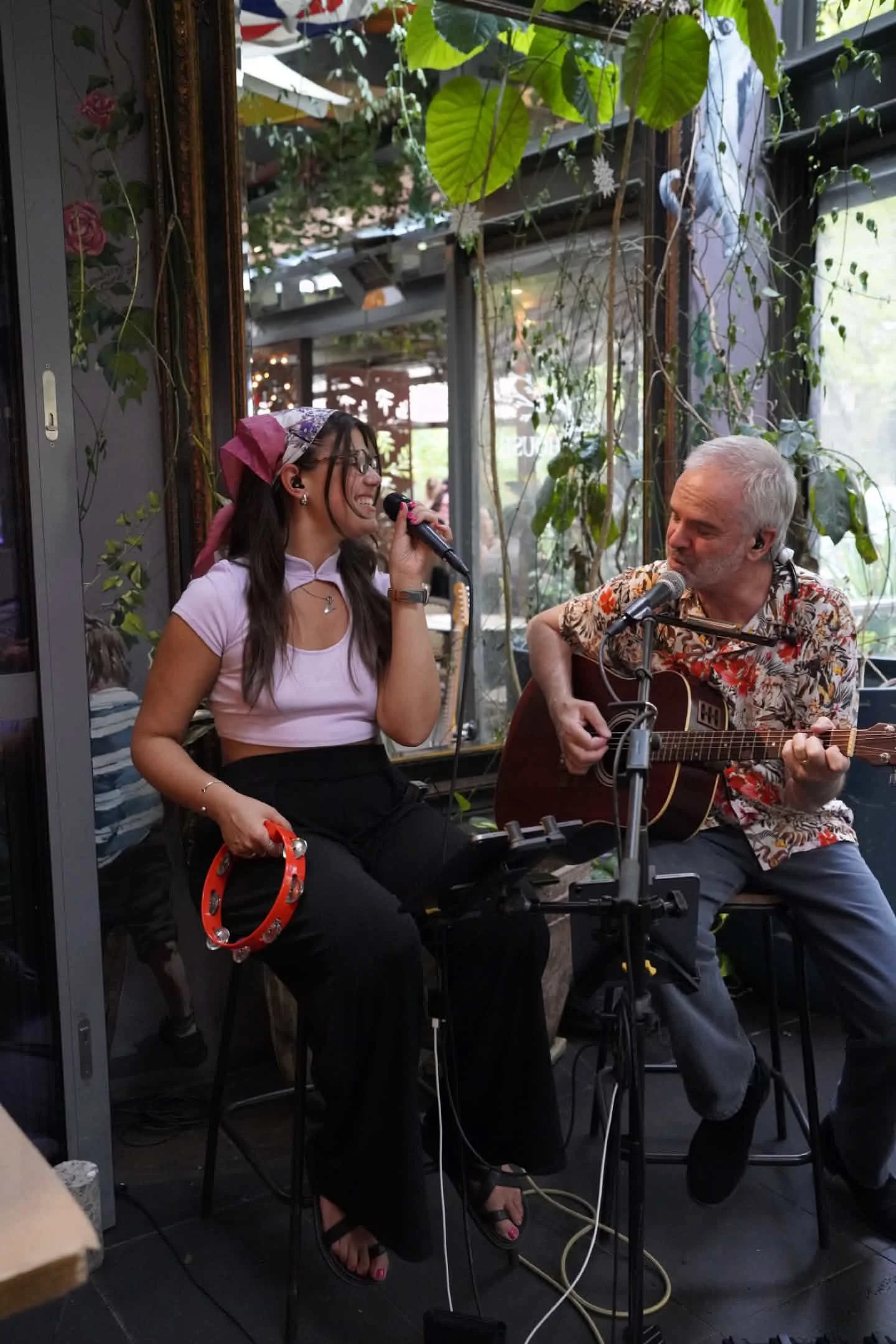
Valeria and Greg performing as The New Normal at the Treehouse in North Sydney.
Yours, in style and curiosity
—
Linda Mulenda