The River Ghost and the Difficulty of Letting Go
What does it mean to let someone go when holding on feels like the last way to love them? That question sits at the heart of Anna Rushmer’s The River Ghost, which I saw on Saturday 26 September 2026 at Flow Studios in Camperdown as part of the Sydney Fringe Festival. With Kate Stewart and Anna Rushmer as directors, the production brings together theatre, music and dance to explore loss and the difficult question of how to move forward.
For those who haven’t read my interview with Anna, she is a writer, director, performer and musician and the founder of Wren Wants a Top Hat, an independent theatre company based in Sydney. Established in 2024, the company brings together different forms of performance to explore folklore and new ways of telling stories. You can find our conversation in the Interview section of my website and I highly encourage you to read it before continuing with this piece to get to know the person behind the production.
The show opens with Anna playing the flute and Nathaniel Kong on piano. Their beautiful playing immediately establishes the atmosphere, drawing you into the world of the story before you have quite worked out what awaits you. Anna’s skill as a musician adds another dimension to a production she also wrote, directed and produced. She takes on three roles: the River, Bertie’s mother and Max, Bertie’s potential love interest. The River feels like an embodiment of the water itself, almost like a river spirit, through whose body Bertie’s mother briefly appears.
Rushmer draws on tales centred on water, including The Little Mermaid and Undine, reimagining their themes through a story about identity, choice and the difficulty of moving forward. Alongside her are Miranda Huttley as Bertie, and Ella Roper as Lorelei, with Roper also responsible for the choreography.
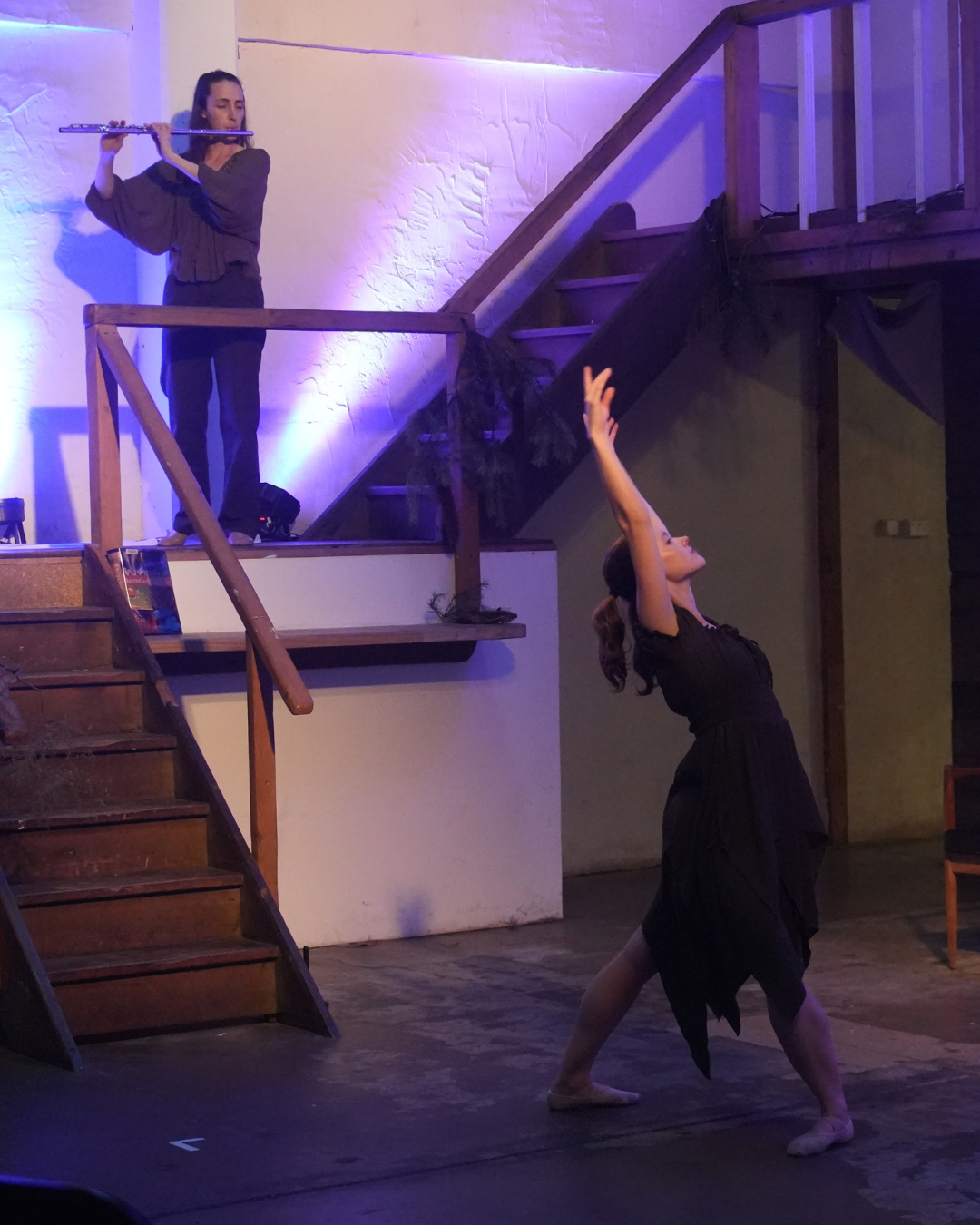
Anna Rushmer playing the flute and Ella Roper as Lorelei dancing.
Credit: Nathaniel Kong
At the centre of the story are two sisters, Bertie (Miranda Huttley) and Lorelei (Ella Roper) and the river that connects them. Following Lorelei’s drowning, Bertie struggles to accept her absence. Lorelei lingers as a ghost or spirit, her presence entangled with Bertie’s memories and guilt. Although she is no longer alive, she continues to exert an influence over her sister’s life. As Bertie becomes caught in the past, the river also begins to stagnate.
That stagnation has real consequences for Bertie. Obsessed with bugs, she dreams of studying biology at her dream university, but Lorelei’s lingering spirit keeps her from taking that step. Her fascination with insects makes this ambition feel especially personal. She has a clear sense of what excites her, yet she keeps postponing the chance to build a future around it. The same pattern emerges with Max, whom she meets at the diner, where Lorelei’s ghost remains by her side. Even in death, Lorelei discourages Bertie from pursuing that connection, keeping her tied to their shared past. University and a possible relationship with Max represent opportunities for Bertie to discover who she might become. Pursuing either would mean allowing her life to change, something she struggles to do while holding onto her sister. Her grief reaches beyond her memories and into the decisions that shape her future.
The river offers a compelling way to express that conflict. A river is something we expect to move. When it becomes still, the question is what has interrupted its course and what it might take to allow movement again. Bertie faces a similar difficulty as she tries to preserve her connection with Lorelei while making room for a life of her own.
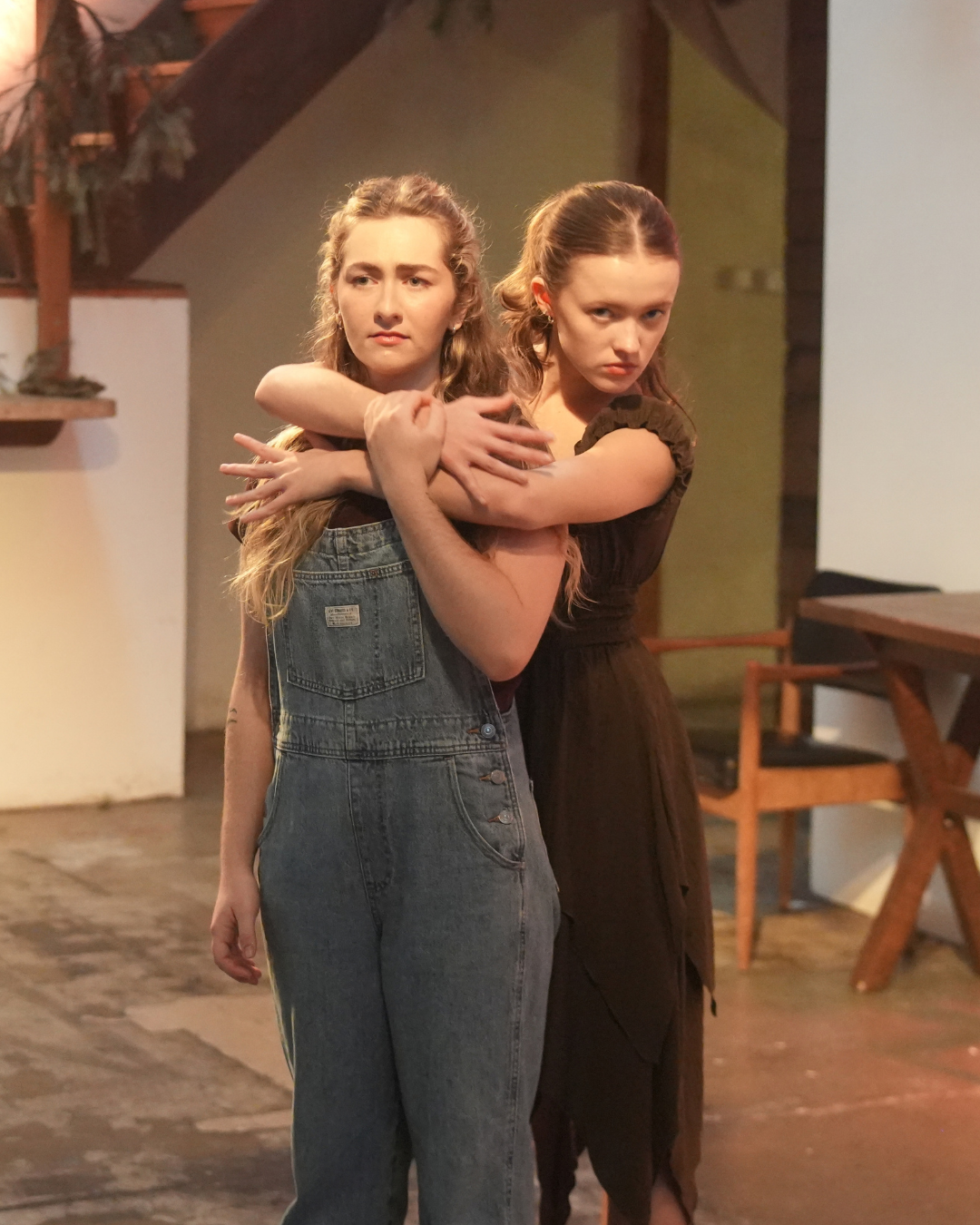
Bertie (Miranda Huttley) in the foreground, with Lorelei (Ella Roper) behind her.
Credit: Nathaniel Kong
Some of the most memorable moments were when the three performers moved in unison or sang together. Their shared movements and voices gave a visible and audible form to the connections between them. For me, those moments expressed how grief and trauma can tie a family together. Each person carries their own feelings, but their experiences remain connected, shaping how they relate to one another and how they move through their lives.
Grief can be difficult to explain, particularly when love, guilt and fear become tangled together. Here, the combination of movement, music and dialogue allowed those feelings to emerge without everything needing to be put into words.
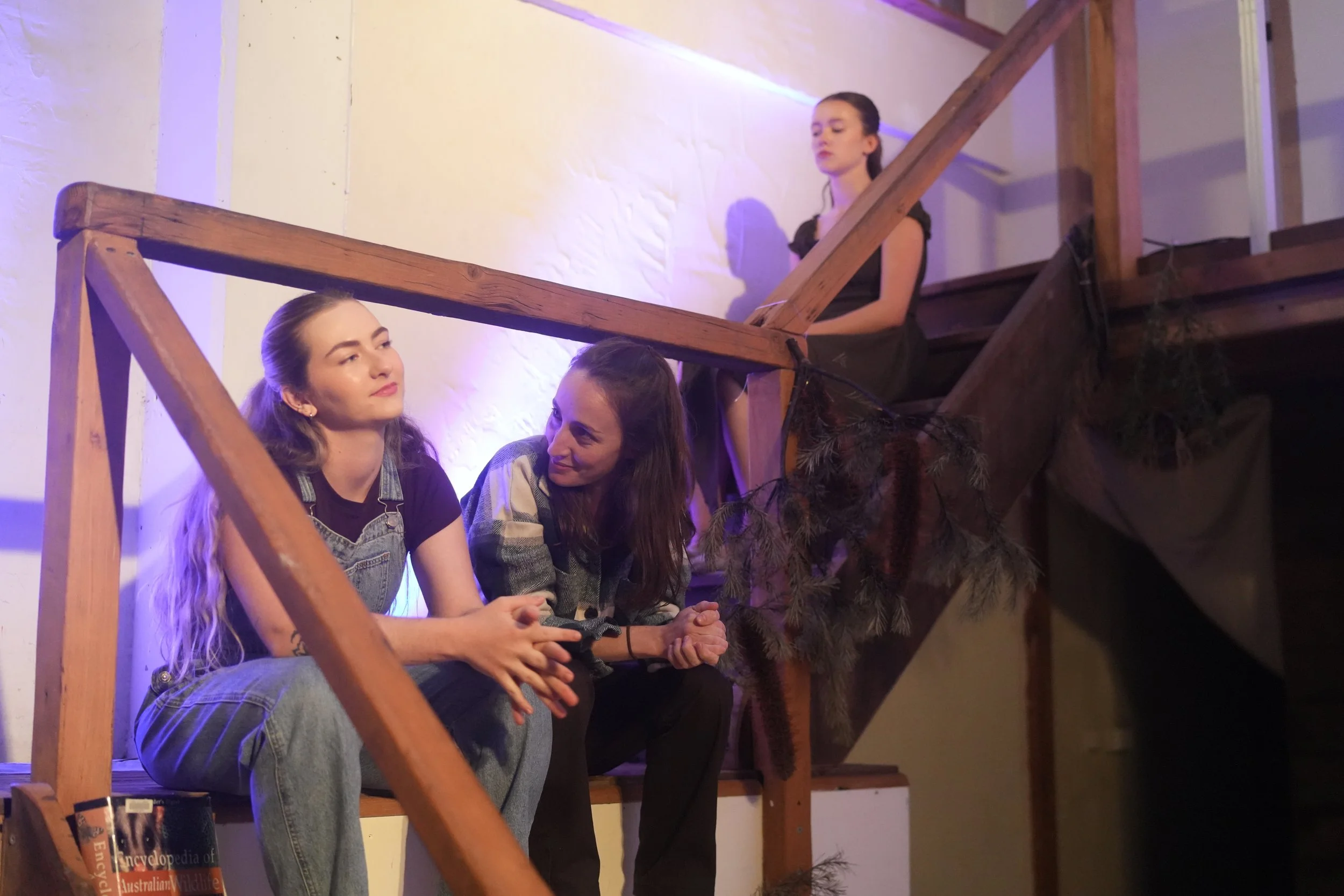
Bertie, Max and Lorelei.
Credit: Nathaniel Kong
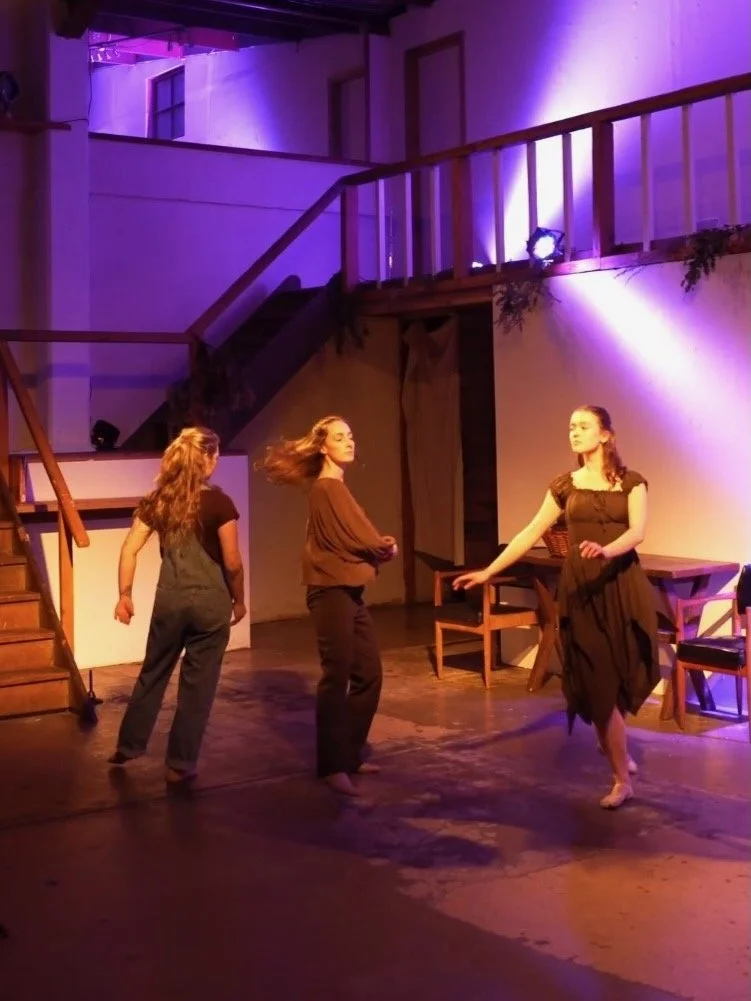
The venue itself added to the atmosphere. Flow Studios has the feel of a warehouse and when the characters stepped on the stairs, you could hear every footstep and creak. Those sounds made me particularly aware of the space around us. It was also incredibly windy that evening. With the wind outside and the building shaking around us, the weather almost felt like an intentional part of the production. I felt a sense of unease as I watched. Perhaps it was the story, perhaps it was the creaking stairs and the wind, or perhaps it was all of those things together. The surroundings seemed to heighten the tension already unfolding between the characters.
It took me a little while to find my bearings in the story, to understand what was happening and where it was heading. Over the years, watching plays, musicals and other live performances has taught me to sit with that feeling of uncertainty and give myself time. I don’t need to work everything out straight away. As The River Ghost unfolded, the pieces gradually came together, and allowing myself that space became part of the experience.
Credit: Nathaniel Kong
For me, one of the central ideas is that letting someone go does not mean loving them less. There is something deeply human about the fear that moving forward might diminish our love for someone, or that pursuing a future without them amounts to leaving them behind. Bertie’s story reveals how painful that fear can become when it prevents us from living. The River Ghost offers space to consider how we might carry someone with us while still allowing our lives to change. For Bertie, that means giving herself permission to pursue the education and relationships she wants. Loving Lorelei does not have to mean giving that future up.
Having previously seen Anna’s Firehawk, which I found thrilling and at times unsettling, I recognised that feeling of becoming so invested in her characters that I wanted to help them. With The River Ghost, Anna continues to create worlds that leave me uneasy, curious and emotionally involved. This is the second of Anna’s plays I have watched and I am excited to see what the third will bring. Good things come in threes, after all.
Yours, in style and curiosity
—
Linda Mulenda